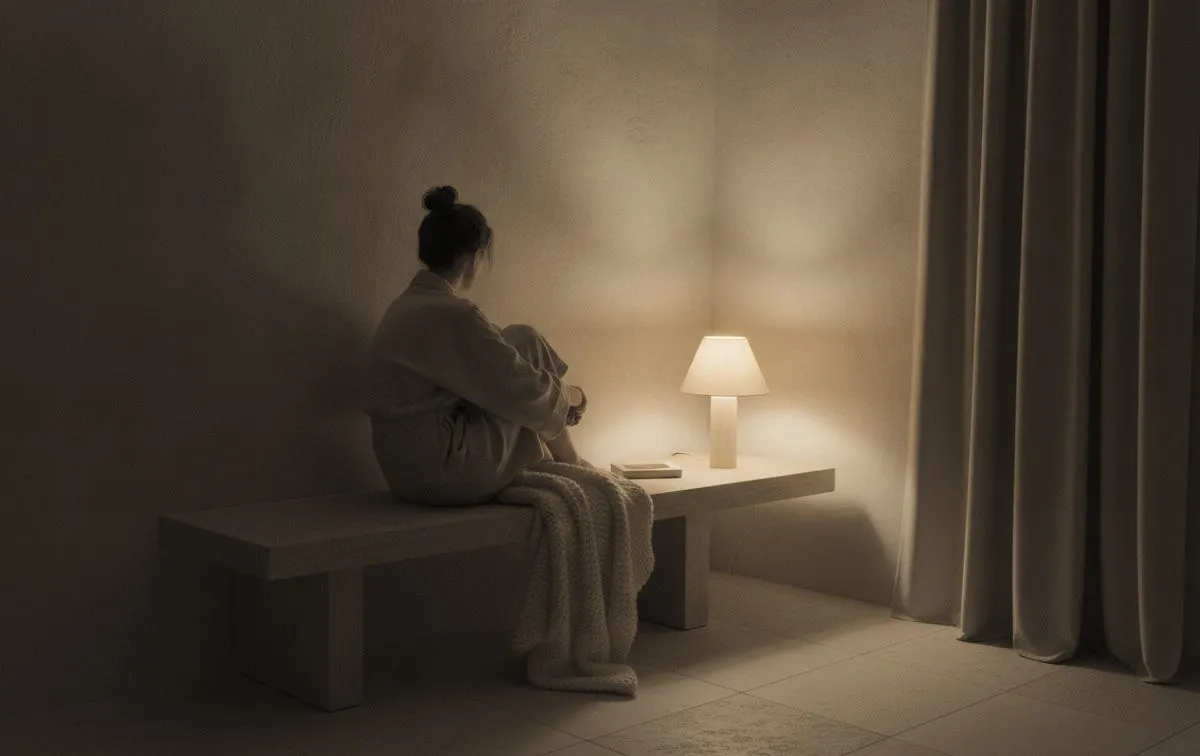
I got the room right.
Lamp instead of the overhead. Blanket folded instead of thrown. The lunch dish already washed, which is the part I usually leave for the version of me who shows up later. By every measure anyone has ever handed me, that room was calm.
I sat down in the middle of it and my jaw stayed exactly where it was.
For a long time I read that as a defect. Everyone else was calming down. I was doing the steps and not arriving.
The rooms that worked
Some rooms did work. It took me years to notice what they had in common.
The corner seat instead of the middle of the couch. The car in the driveway after I’d already parked, engine off, keys still in my hand. The bathroom at a party. The stairwell. Places that were, by any honest measure, worse — hard chairs, bad light, nothing arranged, nothing soft.
What they had was edges.
Something at my back. Something ending the space at a distance I could see. A limit that arrived before I had to make one.
The beautiful empty room had no edges. It asked me to supply them.
(Related: how to build a reading nook that actually holds you — a seat, good light, something soft, and a boundary.)
Calm is a state. Containment isn’t.
Calm is a state, and states have to be produced.
So when the instruction is calm down — or breathe like this, or save the picture of the perfectly lit empty room — what’s actually being requested is labor. Make the feeling. Every version of it asks for that, and none of them mention the room.
The thing that has to manufacture the calm is the same thing currently telling you there isn’t any.
That’s why it fails. Not because you’re bad at it.
(Related: Friday quiet still needs a threshold — one smaller edge instead of the whole weekend at once.)
There’s a word for the other thing. Containment — which sounds like contain yourself, keep it in, hold it together, don’t leak.
But it isn’t something you do to yourself. It’s something the room does.
Walls hold their shape whether or not I’m managing them. A ceiling doesn’t need me to believe in it. When a space has real edges, my body stops running the perimeter, because something else is already doing it.
And here is the part I had backwards for most of my life.
I thought you relaxed, and then you felt safe.
It goes the other way. You get held, and the relaxing happens on its own, slightly before you notice. That’s how you can tell you didn’t do it.
I don’t think I knew I was building a theory until I looked at what was left over. I’d been making and deleting these images for two years, and the ones that survived all had the same handful of things in them.
A horizon line. A limit that isn’t a threat.
One light source. You always know where you are in the room.
Heavy fabric. Satin with weight in it, the kind that ends a wall.
Everything slightly off-center, so nothing in the frame asks you to be the middle of it.
And a figure with no face — because being seen and being held are different needs, and most days only one of them is safe.
None of that is calm. It’s architecture.
What I stopped doing
I don’t have steps for this, and I’ve stopped trying to build them.
But if you’ve been failing at calm, it may be the wrong thing to be failing at. You’ve been making it from scratch, with no walls, every time — and then reading the result as character.
You’re allowed to want the smaller room instead of the open one.
You’re allowed to sit in the corner at the party.
The chair with something behind it — you don’t have to explain that to anyone, including yourself.
You’re allowed to stop making calm and let something else hold the shape for a while.
I still get the room wrong. Folded blanket, right lamp, jaw exactly where it was.
I’m just no longer convinced that’s about me.
Where do you actually settle — the calm room, or the small one?