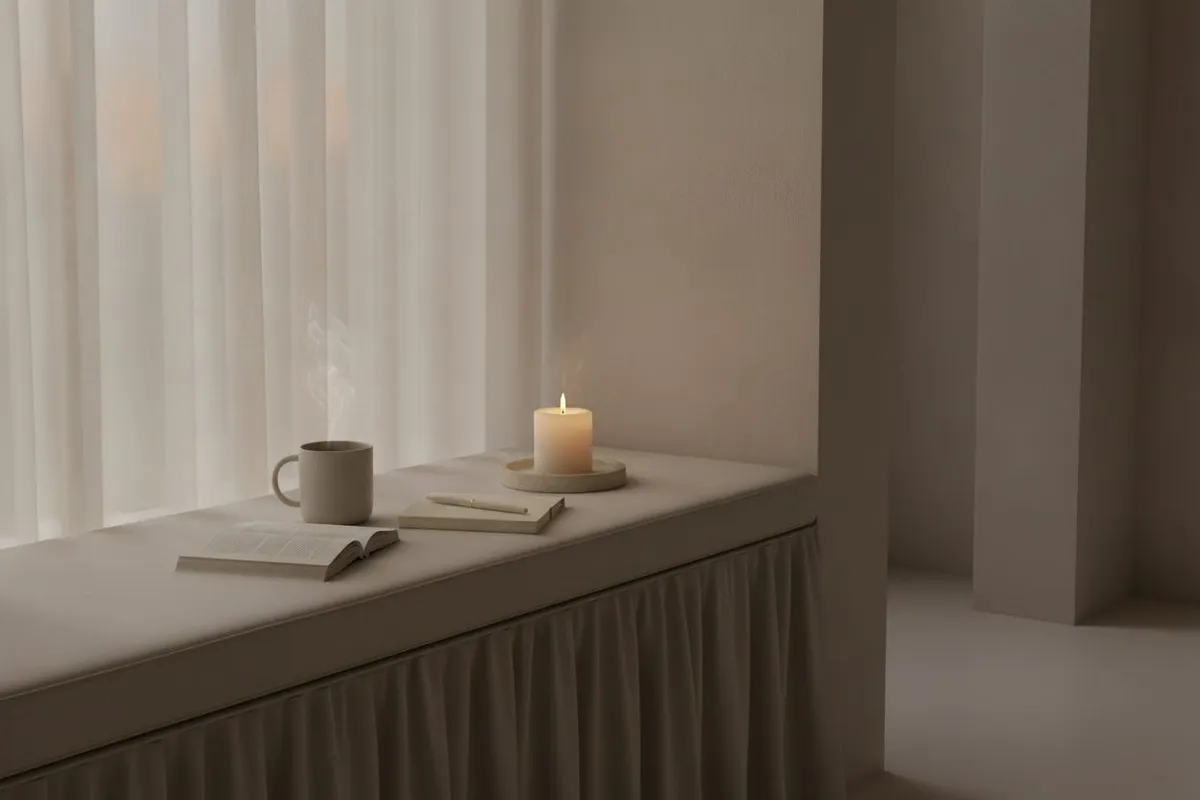
There are Fridays when the week has technically loosened its grip, but your body does not fully agree.
The messages have slowed down. The obligations are no longer arriving in the same shape. The room is softer than it was at noon. Maybe a mug is already warm beside you. Maybe you have already pulled one book from the shelf. Maybe the lamp has been turned on in the corner where nothing else is supposed to happen.
And still something in you remains slightly upright.
Not rushed exactly. Not actively working. Just not fully convinced that the mode has changed.
I think this is one of the quieter forms of end-of-week exhaustion. It does not always feel dramatic enough to call stress, and it does not always feel clear enough to call rest guilt. It often feels more like a small internal delay. A hesitation before you let Friday become evening. A sense that the weekend may be near, but your body is still asking for one more visible threshold before it believes the week is actually over.
That threshold is rarely large.
Usually it is made of something ordinary: one chosen seat, one lit corner, one closed notebook, one page already waiting, one mug that does not require another decision. The body does not always need a transformation. Sometimes it needs proof of change in a form that can be touched.
(Related: what a reading nook needs — the four things, and how to fit them in a small or rented space.)
That is what I keep returning to lately. Not how to make an evening impressive enough to feel restorative. Just how to make it believable.
The pattern
A lot of people imagine end-of-week rest as a dramatic shift.
You push through the final tasks. You close the laptop. You exhale. The weekend begins.
But that is not how it feels for many nervous systems, especially the ones that have spent the whole week in subtle attendance.
By attendance I mean more than visible work. I mean the low-grade posture of watching, responding, remembering, anticipating, holding threads together before they turn into problems. The kind of week where attention has been partially outside the body for hours at a time. The kind of week where your system has been trained to keep listening for what comes next, even during moments that look calm from the outside.
When Friday arrives after that kind of week, quiet can feel strangely incomplete.
Not because you do not want it.
Because your body has not crossed into it yet.
The room may already be offering softer instructions. Light thins out. Objects become smaller. The field of the day narrows from tasks to surfaces. A mug on a ledge. A book on a bench. Satin falling from the edge of a seat. A curtain making the light less direct. These are not decorations in the deeper sense. They are cues. They tell the nervous system that the demands shaping the room have changed.
The difficulty is that a tired system does not always trust those cues immediately.
Sometimes it stays in a half-held position, still listening, still slightly prepared, still wondering whether another demand will come through the door in a different voice. That is why Friday evenings can feel oddly provisional. The structure of the week has loosened, but the body is still operating as if the next ask may be just a few minutes away.
In that state, the weekend does not feel absent. It feels unproven.
And when quiet feels unproven, a lot of us reach for one last useful gesture. One more thing to put away. One more room to straighten. One more small competence to offer before we let ourselves believe the week has actually released us.
Why it happens
I do not think the body is necessarily asking for productivity in these moments.
I think it is asking for orientation.
Nervous systems that have adapted to pressure often trust clarity before they trust rest. They know how to move toward the next thing. They know how to answer, fix, schedule, anticipate, or keep the thread in hand. Even when that creates strain, it also creates shape.
Friday evenings remove some of that shape before they remove all of the activation.
The calendar says one thing. The body says another.
This is especially true when the week has been fragmented rather than cleanly finished. A week of messages, low-grade vigilance, emotional labor, context-switching, and unfinished thought loops does not leave behind a satisfying sense of completion. It leaves behind residue. The body can still feel pointed outward long after the most visible labor has ended.
When that happens, quiet can feel too open.
Too interpretive. Too easy to question.
The nervous system begins looking for a smaller threshold it can actually recognize.
That threshold might be sensory before it is emotional. A mug already warm in the hand. The sound of a match catching. A curtain drawn across the brighter part of the room. A chosen page instead of twelve possible forms of leisure. A notebook physically closed with the pen laid across it, so the body can stop reading it as an active demand.
These gestures matter because they are tangible. They do not ask the system to believe in rest as an abstract value. They let it encounter a changed environment first.
I think that is why some of the most regulating end-of-week cues are so small. They do not try to overpower the week with a big new mood. They simply give the body evidence that the room is now organized around a different kind of attention.
(Related: when the rooms that worked were never the calm ones — on edges instead of softness.)
Not performance.
Not readiness.
Not proving that the week was handled correctly.
Just a quieter mode that can be sensed before it is emotionally trusted.
What to do instead
What helps, at least for me, is lowering the threshold for what counts as a real ending.
First, stop waiting for the entire week to feel complete before you allow one smaller transition to count.
A lot of rest guilt hides inside this exact bargain: once everything is handled, then I can soften. But weeks made of partial attention almost never produce that kind of clean ending. Instead of asking whether the week is fully closed, ask what smaller threshold your body might trust right now. One chosen chair. One lit lamp. One mug already poured. One page already open.
Second, let the room carry more of the transition than your mind does.
You do not have to think your way into weekend mode. You can let simple sensory cues hold part of that work. This is where objects become quietly important. The closed notebook says something different than the notebook still waiting. The partly opened book says something different than the shelf full of possibility. The candle already lit says something different than the room still functioning at daytime brightness.
These gestures are not performances of slowness. They are ways of making the change of state more legible.
Third, allow the smaller threshold to count before you feel fully convinced.
This may be the hardest part. Many tired bodies wait for the internal certainty first: then I will know it is okay to stop. But often the sequence works in the other direction. The body softens because something external has already changed in a believable way. The cue comes first. The trust catches up later.
You do not need to feel fully restful to begin receiving a quieter Friday evening.
Sometimes you only need one smaller threshold that the body can recognize without argument.
Closing
There are Fridays when the room is already softer than the body.
The week is receding. The visible demands are thinning out. The evening has placed a few quieter objects within reach.
And still something in you remains slightly unconvinced.
I do not think this means you are failing at rest.
I think it means your body may still be looking for a form of evidence it knows how to trust.
Not evidence that you have done enough for the week.
Just evidence that the room is no longer asking for the same version of you.
A warm mug can do that.
A chosen page can do that.
A closed notebook can do that.
A smaller threshold can do that.
Sometimes the weekend begins there — not in a dramatic exhale, but in one quiet surface that finally feels believable.
(If you need a gentle entry into the weekend — Slow Mornings was built for the Fridays that still feel like they need one more thing before they can begin.)
Reflection question: What is the smallest visible threshold that helps your body understand the week is no longer speaking in the same voice?