You already know the feeling.
The day has been full — not necessarily bad, not necessarily chaotic, just full. Decisions. Inputs. Responding to things. Holding things open for other people. The kind of day that doesn’t feel overwhelming while it’s happening because you’re managing it, but by the time you sit down, the managing has used everything.
And now the room is quiet. And the body is not.
The nervous system is still slightly open. Still scanning. Still holding the shape of the day like a hand that won’t unclench. You know the room is safe — you made it safe, the light is low, the phone is face-down — but the body hasn’t received that information yet.
(Related: when quiet still feels loud — on the evenings that stay wired even after the doing stops.)
The pattern
The pattern is this: you arrive at rest already tired, and then the rest doesn’t work. Not because you’re bad at rest, but because the system is still processing the day. It’s not resting — it’s clearing. And clearing takes a different kind of evening than resting.
Most advice for “how to reset your nervous system” adds more: more breathing, more routines, more techniques, more things to do. But the body that’s been doing all day doesn’t need more to do. It needs less to process. The reset isn’t a practice you perform — it’s the space you create by removing enough that the body can find its own floor.
This is why the bubble bath doesn’t always work. The lavender doesn’t always work. The meditation app doesn’t always work. Not because they’re wrong, but because they’re additions to a system that’s already full. The system can’t take in one more input — even a calming one — without processing it. And processing takes energy.
The reset is the removal.
Why it happens
Your nervous system isn’t designed to stop on demand. It’s designed to wind down — gradually, through reduction, on its own timeline. When you’ve been running on high input all day (even productive, good input), the system accumulates what it’s been processing. Sound, light, decisions, social responsiveness, emotional management. By evening, the body is still holding all of it.
The scanning, the inability to settle, the feeling that the quiet room is too quiet — these aren’t signs that something is wrong. They’re signs that the system is still working through what it was holding. It hasn’t caught up to the room yet.
(If you’re tired of proving you’re fine first: reflections for people tired of proving.)
This is what a nervous system reset actually addresses: the gap between the external conditions (quiet) and the internal state (still processing). You don’t close that gap by adding calm to the outside. You close it by removing enough from the outside that the inside can finish.
(Related: when the push is over but your body is still looking — on why the system keeps scanning after the threat is gone.)
What to do instead
Don’t add a practice. Subtract until the body can arrive.
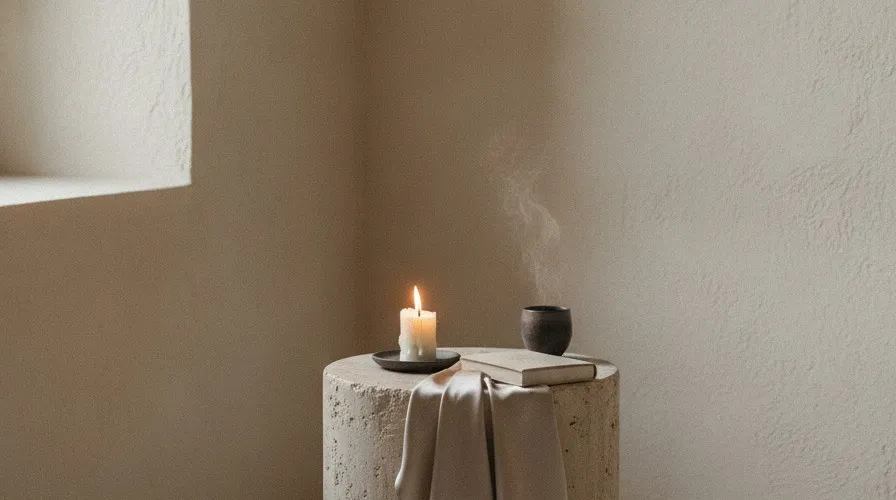
Make the evening smaller before trying to make it better. One corner instead of the whole room. One source of warmth — a lamp, a candle, a mug — instead of a full ambiance. One analog thing to hold (a book, a pen, a blanket) instead of five options. The goal isn’t to create the perfect calm evening. It’s to make the evening small enough that the system can actually enter it.
Lower the input before you lower the expectation. Phone in another room, not just face-down. One light, not three. No music, or one track on repeat until it becomes background. The body needs the input floor to drop before it can drop its own vigilance.
Let the body arrive on a delay. The scanning will continue for a while — that’s the processing, not a failure. Don’t try to stop it. Don’t try to relax harder. Just stay in the small corner and let the system do what it’s doing. It will arrive. The timeline isn’t yours to set.
If rest feels like too much, make it smaller. A full evening of nothing can feel like a void the body rushes to fill. Five minutes of one warm thing is easier to enter than three hours of planned calm. Once you’re in, the body can go deeper on its own.
(If your system needs a structured decompression practice: the Reset Guide was built for exactly this — seven small practices for overstimulated evenings.)
Closing
The body knows how to reset. It’s been doing it your whole life — in the small moments between things, in sleep, in the pause before you open the next door. The problem isn’t that the body has forgotten. The problem is that the days have been so full that the body hasn’t had enough space to do it.
You don’t need to learn how to reset your nervous system. You need to remove enough that the system can remember on its own.
One corner. One warm thing. One page. And the permission to arrive on a delay.
What would change if you stopped trying to calm down and started removing instead?