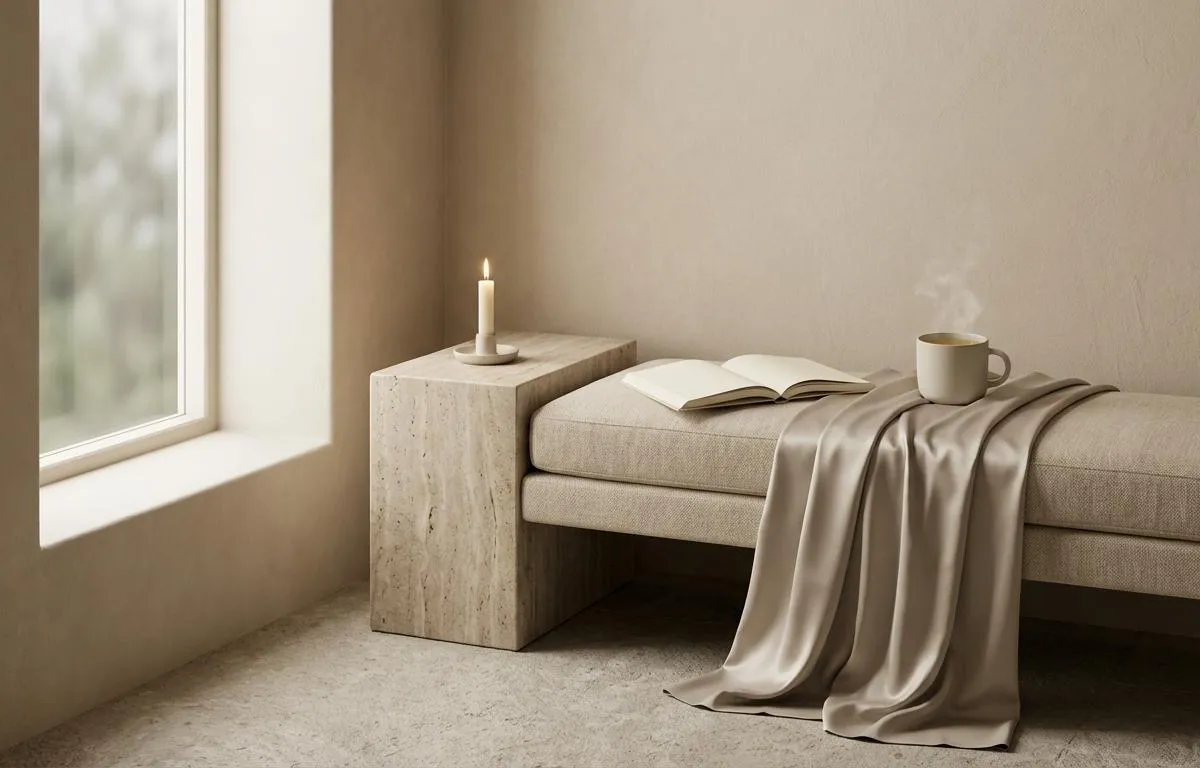
There is a particular kind of quiet that does not feel restful at first.
The room is ready for evening. The light is lower. The mug is warm. The notebook is closed. The obvious tasks have been completed, or at least stopped. Nothing visible is asking to be solved.
And still, the body keeps scanning.
Not dramatically. Not always with panic. Sometimes it is only a subtle reaching forward. A quiet internal lean toward the next thing. One more email to check. One more detail to review. One more small correction that would let the day end in a cleaner line.
This can be confusing because it arrives after effort, not during it. You expect the nervous system to feel strained while everything is happening. You do not always expect it to stay alert when the pressure has already passed.
But often that is exactly when the body begins revealing how much momentum it was using just to keep up.
(This is the quiet after the push — the essay that sits with it longest.)
The room can stop before the body does
A room can shift into evening faster than a nervous system can.
The lamp turns on immediately. The screen goes dark immediately. The cup warms the hand immediately. The room changes state in a matter of seconds.
The body is often slower.
It may still be finishing a conversation that already ended. It may still be bracing against a demand that is no longer active. It may still be organizing, sequencing, reviewing, and scanning for whatever might have been missed while you were busy moving through the day.
(Related: calm wallpapers for a quieter phone — what the screen shows when you unlock it is not neutral.)
This is one reason sanctuary imagery matters so much for Quiet Arrival. The room is not performing calm. It is holding sequence. A bench under a narrow window. A candle on stone. A robe on a hook. An open booklet that does not require urgency in order to be touched. These are cues that the next chapter has already begun, even if the body is late to it.
When a person has spent long stretches of time orienting through usefulness, the end of effort can feel less like relief and more like exposure. Motion has shape. Responsibility has shape. Hyper-attention has shape. Stillness can feel too open at first.
So the task is not to force serenity. It is to create cues gentle enough that the body can notice the day has actually changed.
Why the after-pressure can feel heavier than the work
A lot of tired people assume that if they are still activated after the push, they must have done something wrong with their evening.
I do not think that is usually true.
I think after-pressure often comes from the nervous system trying to make sense of an abrupt drop in demand. When the day has required tracking, anticipating, responding, and staying a half-step ahead, the body can begin treating vigilance like structure. It knows what to do with a problem. It knows what to do with a deadline. It even knows what to do with exhaustion, because exhaustion at least confirms that the body had a job.
But the softer in-between state is harder to trust.
That is where many people get caught. They do not feel fully in work mode anymore, but they do not yet feel settled enough to receive rest. They sit down, but mentally stay standing. They close the laptop, but keep reviewing the internal list. They make the tea, but do not let the tea mean anything.
This is not a motivation problem.
It is often a sequencing problem.
The body needs a believable bridge between effort and arrival. Not a dramatic reinvention. Not a heavily optimized routine. Just enough sensory coherence that the evening stops feeling like an empty field and starts feeling like a place with edges again.
What helps when your system keeps searching for the next thing
I find it helps to lower the complexity of the landing.
Not the beauty of it. The complexity.
A smaller number of decisions. One clear place to sit. One warm object to hold. One page to look at. One light source. One physical cue that the day is no longer asking for the same pace.
That is why so many of Quiet Arrival’s strongest scenes involve architectural containment and a tactile triad: steam, paper, and light. Together, they do something language alone cannot always do. They give the body enough evidence to loosen by fractions.
If the body is still scanning after effort, try not to make that a moral event.
It may simply mean the system is arriving on a delay.
You do not have to resolve the whole day in order to let the room begin holding you.
You do not have to believe in rest perfectly for a bench, a lamp, and a warm mug to help.
You do not have to transform the evening into a ritual worthy of documentation.
Sometimes the quietest, truest shift is only this: you stay seated long enough for your breathing to stop chasing the rest of you.
A softer way to read the evening
The evening does not have to prove that it worked.
You may still feel unfinished.
You may still feel slightly alert.
You may still notice the urge to stand back up, to check one more thing, to make the room “count” by becoming more productive or more beautiful or more complete.
But if you can let one cue stay steady — the mug, the chair, the candle, the same page open in the same small corner — then the evening has already begun doing something useful in the quietest possible way.
It is helping the body rehearse an ending that does not depend on collapse.
And for many nervous systems, that is not a small thing.
(For the evenings your body is still scanning: the Reset Companion was built for the window after the push — a body-based practice for the nights your system won’t let go on its own.)
Reflection question: What object or corner in your evening already tells your body the push is over, even when your mind is slower to believe it?