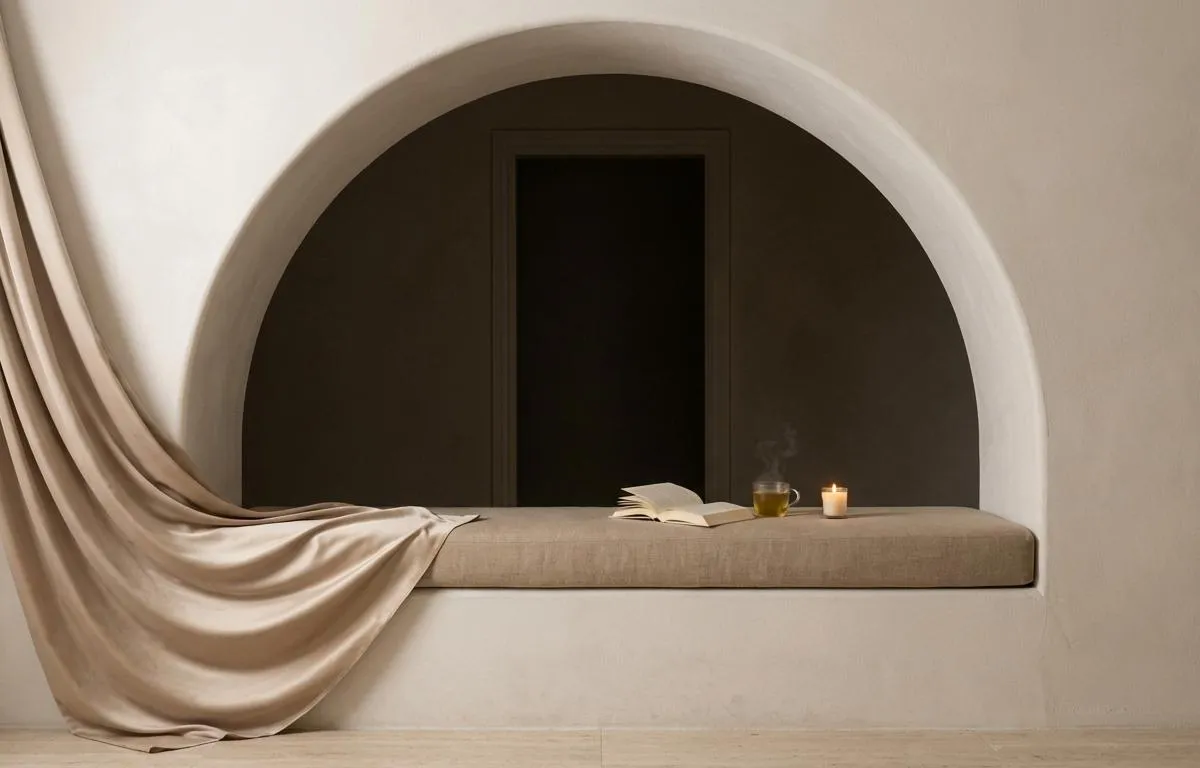
There are evenings when the room is quiet in every visible way.
The lamp is low. The mug is warm. The book is open to the same page it has been open to for ten minutes. Nothing is urgent. Nothing is ringing. Nothing is technically wrong.
And still, your body does not arrive with the room.
It stays slightly ahead of you, as if some invisible part of it is still walking quickly through the day, still carrying small unfinished alarms, still expecting the next demand to come through the door.
That gap can feel confusing when you have done all the “right” things. You made the tea. You sat down. You created the conditions that are supposed to feel restorative. But the inside of you is not matching the outside yet.
That mismatch is often where shame tries to enter. If the room is soft, why am I not soft yet. If the evening is calm, why do I still feel slightly braced.
(Related: when calm itself feels like a threat — when the gap runs even deeper than a mismatch.)
The room gets there first
A room can become quiet faster than a nervous system can.
That is not failure. It is sequence.
The body does not usually trust a new state because it was explained well. It trusts what is repeated without harm. It trusts what stays gentle long enough to stop feeling like a trick. It trusts the mug that is warm every night, the lamp that lowers the edges of the room the same way, the chair that does not ask anything of your spine except that it be held.
This is one reason sanctuary imagery resonates so deeply for tired people. It is not just decorative preference. It is pattern recognition. A bench under soft light, a book turned open, a curtain barely moving, a robe waiting on a hook — these are not merely beautiful objects. They are believable cues. They say, without saying much, that nothing else is about to happen.
(If the room itself is still unfinished: minimalist wall art that stays warm — why empty and calm are not the same thing.)
Sometimes the room becomes the first trustworthy thing in the sequence.
Not because rooms are magical. Because the nervous system is concrete. It reads texture, temperature, light, enclosure, repetition. It notices whether the air feels sharp or forgiving. It notices whether there is a place to put the day down.
And when you have lived for a long time in response mode, sometimes that kind of cue has to arrive before insight does.
Why insight alone doesn’t always lower the body
You can understand yourself very accurately and still not feel safe yet.
You can know that you are not lazy, not failing, not behind, and still feel your shoulders stay lifted when the evening begins. You can have language for burnout, language for hypervigilance, language for over-responsibility, and still feel your body search the room for the next assignment.
This is not because the insight was false.
It is because cognitive understanding and physiological trust are related, but they are not identical.
A lot of exhausted people try to think themselves into calm because thinking has been the most available tool for so long. If I can explain it well enough, maybe I can stop feeling it. If I can name the pattern quickly, maybe I can move through it without having to wait.
But the body is slower than interpretation.
It often needs the proof of a non-demanding environment repeated across many ordinary moments. A low light. A stable surface. A hot drink that asks only to be held. The same corner at the same hour. The same small sequence that says: nothing is chasing you now.
This is part of why tiny rituals matter more than dramatic resets. A believable cue repeated gently is easier for the body to trust than a beautiful life overhaul it cannot maintain.
What to do when the room is ready but you are not
Start smaller than transformation.
Let the room do more of the work.
Choose one place that can become your landing place on purpose. Not the whole home. One surface, one chair, one bench, one side of the bed. Give it only a few jobs: hold light, hold warmth, hold one tactile object that tells the truth about the hour.
Then keep the sequence plain.
A mug. A lamp. A book or notebook. A sentence if you need one, but only one.
You are not building an aesthetic performance. You are building recognizability for a nervous system that has been asked to pivot too quickly for too long.
And if you sit there and still do not soften right away, let that be part of the ritual too. The point is not to produce immediate serenity. The point is to stop making calm prove itself instantly.
Sometimes the most honest evening practice is allowing the room to be calm on your behalf for a little while.
To sit inside a softness you do not fully feel yet.
To borrow regulation from the lamp, the steam, the folded fabric, the closed door, until your body begins — slowly, believably — to notice that nothing worse is arriving.
A quieter way to measure the shift
The shift is not always that you feel peaceful.
Sometimes the shift is that you stop standing back up.
Sometimes it is that you reach for the book instead of your phone. That you let the tea cool because you were actually sitting long enough to forget about it. That you notice the room around you instead of moving through it like a hallway between obligations.
Sometimes the shift is only that the space no longer feels like another place where you must perform being okay.
That is still a shift.
The body rarely announces trust dramatically. More often it eases into it by fractions. By one less internal flinch. One less urge to prove you are using your time correctly. One more evening where the room feels slightly less foreign and your own life feels slightly more inhabitable.
If that is where you are, you do not need to call it progress if that word feels too loud.
You can simply call it a softer landing.
And you can keep giving your body somewhere believable to arrive.
(If you’re building a space your body can trust: the prints and the Quiet Room wallpapers bring together the reading nook and the quiet room — the visual cues that make a room feel like an arrival, not a performance.)
Reflection question: What cue in your space already makes your body feel a little less watched, and what would it look like to trust that cue more often?