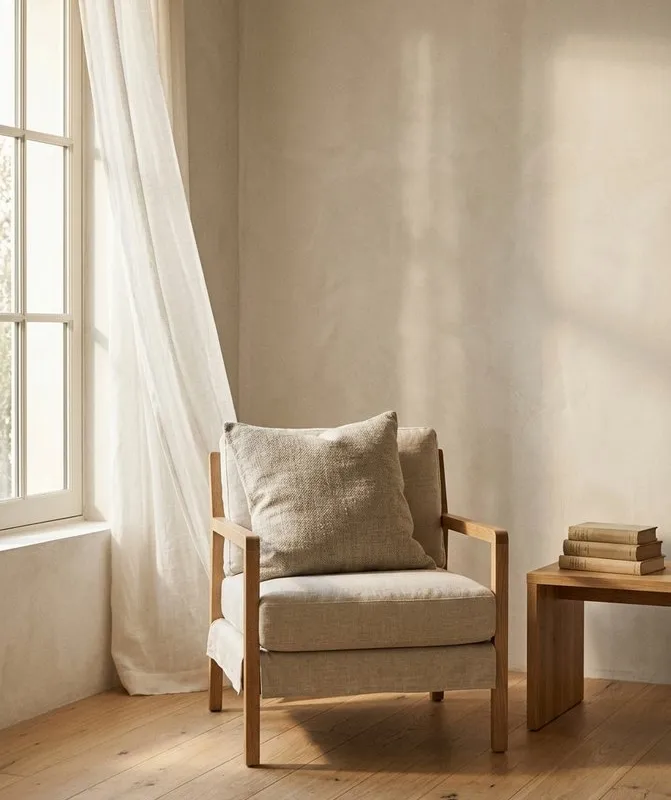
You don’t need a spare room. You don’t need a window seat, or a library, or square footage you don’t have. You need four things: a seat, good light, something soft, and a boundary — some small signal, even an imagined one, that says this corner is for slowing down.
That’s the whole formula. Everything else — the styling, the shelf, the art on the wall — is just the part that makes the corner feel like yours. Here’s how to build it, piece by piece, whichever kind of space you’re working with.
What Makes a Reading Nook Feel Cozy
A reading nook isn’t defined by size. It’s defined by containment — the sense that this particular spot is smaller than the room around it, and that smallness is the point. A chair pushed into a wide-open living room rarely feels cozy, even if it’s the most comfortable chair in the house. The same chair angled into a corner, with a lamp beside it and a throw across the arm, suddenly reads as a place.
So before anything else, look for containment rather than space. You’re not looking for the biggest available spot — you’re looking for the one with edges. A corner where two walls meet. The end of a hallway. The dead space beside a bookshelf. A window with a bit of wall on either side. Anywhere the room narrows slightly is a candidate.
The four essentials, again, in a little more detail:
- A seat — doesn’t need to be dedicated. A chair you already own, moved six inches into a corner, counts.
- Good light — warm and low, not overhead and bright. More on this below.
- Something soft — a throw, a cushion, a rug underfoot. Texture is what turns “a chair” into “a nook.”
- A boundary — anything that marks the edge of the space, even loosely: a rug, a low shelf, an angled chair back, a curtain.
Choosing the Spot
Walk your home slowly, the way you would if you were looking for a place to set down a cup of tea and stay a while. You’re not looking for the room with the most floor space — you’re looking for the room’s quietest edge.
A few places worth checking that people usually overlook:
- The end of a bed, if there’s a foot or two of wall beside it.
- A wide hallway landing, especially near a window.
- The unused side of a bedroom, opposite the bed.
- A closet with the door removed, if it’s deep enough for a small chair — an unconventional but genuinely cozy option.
- A corner of the living room, angled slightly away from the main seating so it reads as its own space rather than an extension of the couch.
If nothing in your home has an obvious corner, you can still make one. Two pieces of furniture — a bookshelf and a chair, or a floor lamp and a low table — placed at an angle to each other will create an edge where none existed. You’re not waiting to find the perfect alcove. You’re building a small one out of what you already have.
Small-Space and Renter-Friendly Nook Ideas
This is where most reading-nook advice quietly assumes you own the walls. You may not. Here’s the version that doesn’t ask you to drill anything.
Work with a single chair, not a “reading room.” In a studio or a one-bedroom, the nook might be six square feet — a chair, a small side table, a lamp. That’s a complete nook. It doesn’t need a matching set of furniture around it; it needs those four essentials and nothing competing for attention nearby.
Use a folding or slipper chair if floor space is tight. Something narrow enough to tuck away when you need the room back, but comfortable enough to actually sit in for an hour.
Define the space with a rug instead of a wall. A small area rug — even one you already own — placed under just the chair and side table does the same job a doorway would: it tells your body this is a different zone the moment you step onto it.
Renter-friendly wall options, no holes required:
- Leaning art, propped against the wall on a shelf or the floor rather than hung. This is often more atmospheric than framed-and-hung — it reads as intentional, unhurried.
- Removable hooks or strips rated for the weight of what you’re hanging (check the rating before you trust it with anything heavier than a light print).
- A tension rod with a curtain panel, used to soften a corner or partially enclose a nook — no hardware in the wall at all.
- Peel-and-stick or printable wall art and wallpaper, which can define an entire accent wall or a single soft panel behind the chair without a single nail.
- A folding screen or room divider, which does double duty as both the “boundary” element and a piece of decor.
None of these are compromises. A leaning print and a warm lamp will make a rented studio corner feel more like a nook than an expensive built-in reading room with the wrong light.
Getting the Light Right
Light is what separates a chair-in-a-corner from an actual nook, and it’s the piece people get wrong most often by defaulting to whatever’s already overhead.
Avoid the main ceiling light. Overhead lighting flattens a space and makes it feel like the rest of the room — bright, general, functional. A nook needs its own light source, low and warm.
A floor lamp or a small table lamp beside the chair does the real work. Look for a warm bulb (soft white, not daylight-toned) and a shade that casts light downward rather than up into the room. The goal is a small pool of warmth around the chair, with the rest of the room slightly dimmer by comparison — that contrast is what makes the corner feel separate.
If there’s a window nearby, let it do double duty. Natural light during the day, warm lamp light in the evening. A nook that works at both times of day gets used far more than one built only for golden-hour photos.
The Textiles That Make It Soft
This is the fastest, cheapest way to make any corner feel like a place to stay a while.
- A throw draped across the arm of the chair, not folded flat — the slightly undone look reads as lived-in rather than styled.
- A cushion or two, in a texture that invites touch: linen, waffle-weave, brushed cotton. Avoid anything too structured or slick.
- A small rug or sheepskin underfoot, especially on hard flooring — bare feet on a cold floor undoes a lot of the coziness a nook is trying to build.
- Warm, low-saturation color — oatmeal, cream, warm taupe, soft clay. These read as calm in a way that brighter or cooler tones don’t; they let the eye settle instead of scanning.
You don’t need to buy a full set. One good throw and one rug will do more than five mismatched cushions.
Styling the Nook
Once the seat, the light, and the softness are in place, the styling is really just a short list of small, quiet objects — not a full shelf of decor.
- A stack of two or three books you’re actually reading, not the ones you’re saving for show.
- A small side table, low enough to reach without leaning.
- A mug-sized coaster or a little tray, so tea has somewhere to sit besides the floor.
- One plant, if the light supports it — something low-maintenance rather than fussy.
Resist the instinct to fill every surface. A nook with a little visual room to breathe feels more restful than one that’s been fully decorated. The empty space around the few objects you keep is doing as much work as the objects themselves.
What to Put on the Wall
The wall behind or beside the chair is the last piece, and it’s worth choosing with a little care, because it’s what your eyes land on when you look up from the page.
Aim for a single, soft-toned piece rather than a gallery wall — something with warm, muted color and a quiet scene, not high contrast or busy patterning. One anchor piece does more for the feeling of the corner than four smaller ones competing for attention. If you’re renting, lean it against the wall on a narrow shelf or the floor instead of hanging it; propped art has its own kind of ease to it.
This is exactly the gap calming reading-nook wall art was made to fill — soft, low-contrast pieces sized and toned for a small corner rather than a full room. If you’re building the wallpaper version of this instead of framed art, the quiet room wallpapers work the same way behind a chair or across an accent wall, no hanging required.
A Soft Place to Land
None of this requires a renovation, a spare room, or a weekend of furniture shopping. It requires one chair, one lamp, one soft thing, and the decision that this particular six square feet of your home is allowed to be just for slowing down.
Start with the smallest version. A chair, moved into a corner, with one lamp and one throw. See how it feels to sit there for ten minutes before you add anything else. The nook will tell you what it needs next.
(For the wall behind it: minimalist wall art that still feels warm, or how to choose neutral wall art without it going flat.)
And if you’re looking for the last piece — something quiet to hang above the chair, or a soft wallpaper to settle the wall behind it — that’s the part of the shop this corner was built for.