It was somewhere around the fifth time I’d unlocked my phone before getting out of bed that I noticed I was already braced. The screen hadn’t loaded anything alarming. No bad news. No missed call. Just the lock screen, and already my shoulders had moved slightly forward, already something in my chest had tightened a little in preparation. For what, exactly, I couldn’t have said. Just: something.
That’s where I was — halfway between sleeping and awake, phone in hand, body already in a posture of readiness — when I started wondering what my home screen was actually doing to me before I even got to the apps.
The Pattern
Your phone is probably the first thing your nervous system responds to in the morning and one of the last things before sleep. And the visual it shows you in that half-second before anything loads — the lock screen image, the home screen background — is a cue your body is reading even when your conscious mind is still waking up.
Most of us have never chosen that cue deliberately. It’s a default image from the manufacturer. A photo we set two years ago that meant something then and now mostly functions as wallpaper. A productivity grid. An aesthetic we picked because it looked good as a thumbnail, not because of how it would feel on the four-hundredth unlock of a Wednesday.
The phone is not neutral. It either adds to the ambient static your nervous system is already managing, or it doesn’t. For a long time, mine was adding to it.
Why It Happens
Small environmental cues accumulate in the body without asking permission. This is not a flaw in how nervous systems work — it’s the whole point. Your system is constantly reading the environment for information about safety and threat, and it’s doing this faster than cognition can catch up. The light quality in a room. The sound level. The visual field you encounter when you look up from whatever you were doing.
A wallpaper is a small version of all of that. It’s the visual you see more times per day than almost any other object in your life. Not a long look. Not a meaningful one, necessarily. But the signal it sends — this is a space that asks something of you or this is a space that just exists — lands at the level where nervous system cues actually operate.
I am not saying a phone wallpaper will regulate a dysregulated nervous system. I want to be honest about that. What I find is that it’s one piece of a larger thing: the accumulation of small signals that your body uses to decide whether it’s safe to exhale.
What I’ve Found Instead
The five scenes in The Quiet Starter were not chosen because they’re beautiful, though I think they are. They were chosen because nothing in them is asking for a response.
Threshold holds the kind of light that exists before a day asks anything of you — a liminal quality, a not-yet. I find it softens the first reach.
Vespers is evening that isn’t productive evening. Just the particular quality of light that visits when the day is technically finished but you’re still arriving at the understanding of it.
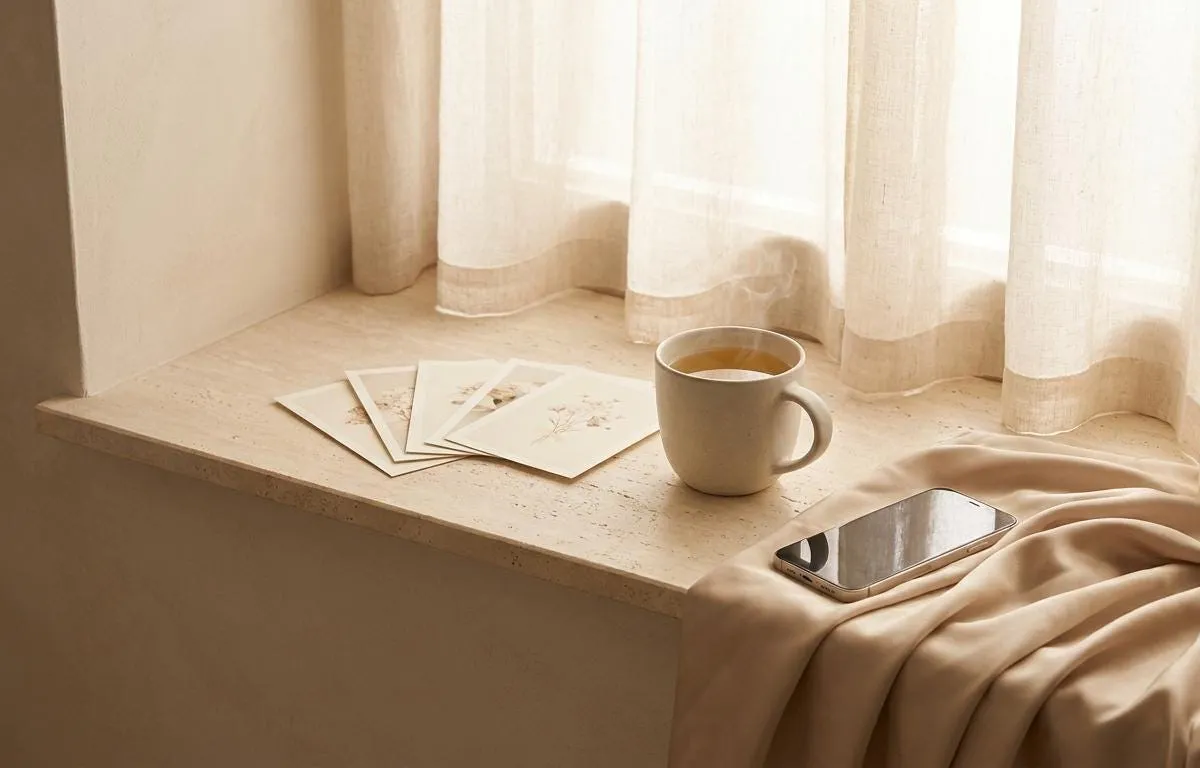
Chamomile is two hands around a bowl of tea, and unhurried. Nothing in it has an urgency. It is simply there, the way a held cup is simply there, without needing to justify the space it takes up.
Steeping is the image of waiting that isn’t anxious waiting. A pause with a natural end you don’t have to manage. I notice it genuinely slows the pace of whatever I’m about to open.
Altar is a small arranged space — a few objects placed with intention in soft light. Not aesthetic performance. Just evidence that someone made a deliberate quiet corner, and that it was allowed to stay that way.
You are allowed to have a phone that softens the moment before anything loads. You are allowed five images that do nothing except exist gently. You don’t have to earn that.
A Note About the Letters
The letters went quiet for a while. There isn’t a neat explanation — only the honest one, which is that I needed to stay close to what this space is actually for rather than fill it with something I wasn’t ready to write.
This newsletter doesn’t run on a schedule. It arrives when there’s something worth slowing down for. That’s still the intention, and I wanted to name it plainly rather than disappear without acknowledgment.
If you stayed, thank you. If you just arrived, welcome. Either way: the space here is the same as it’s always been — unhurried, without agenda, not trying to fix anything.
Closing
The Quiet Starter is free. It has always felt off to me to charge for permission.
You can find the full set at the Quiet Starter. Five wallpapers sized for phone screens. Leave an email and they arrive — no payment, no catch. Just the images, and whatever the images do.
(Related: calm wallpapers for a quieter phone — what actually makes a background calm, if you want more than five.)
If you want to stay in this space — letters sent when there’s something worth the pause, never on a schedule — you’re already here.
Rest is allowed. Even on the device that usually works against it.
(For more wallpapers with the same nervous-system-first design: Quiet Room Wallpapers extend the collection for desktop and tablet — each one chosen for low visual demand, not aesthetic performance.)
What does your phone look like when you pick it up first thing? Not what does it say — what does it look like?