You finally make it to the quiet part of the day and your whole body flinches.
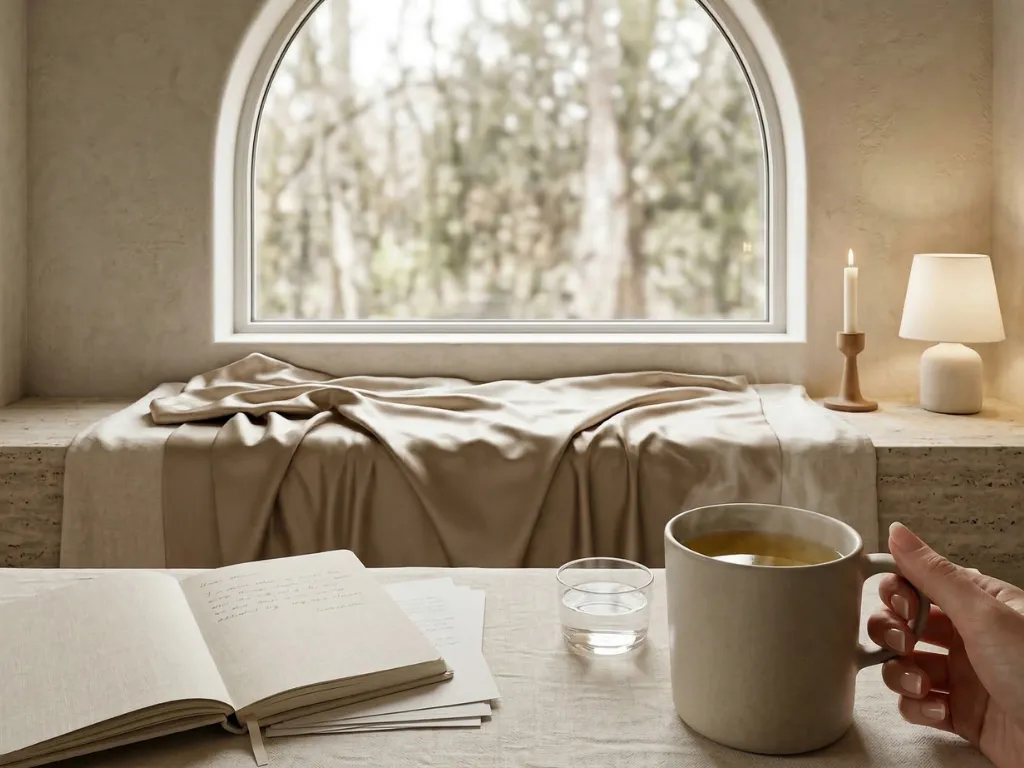
The house is softer than it’s been in hours. The tabs are closed. The mug is warm in your hands. The room is doing that evening thing where the edges blur and the light sits in one corner instead of everywhere.
And instead of relief, there’s a small, sharp panic under your ribs.
You notice it when you reach for your phone even though you promised yourself you wouldn’t scroll tonight. When you stand up to check something that doesn’t actually need checking. When a thought appears out of nowhere: I should be using this time better.
(Related: calm wallpapers for a quieter phone — the smallest surface you look at most.)
Calm, as an idea, sounds holy. As an actual room you have to sit inside, it can feel like walking into a space where everyone else already knows the steps and you don’t.
When motion has been the way you stayed safe
You’ve spent a long time being good at motion.
Maybe your days have been measured in things finished, messages replied to, people cared for. Maybe the only way you knew to prove you were trying was to never stop moving. Even your rest had a job: recover just enough to go again.
So when the evening finally slows and nothing is asking anything of you, your nervous system doesn’t automatically register “safe.” It registers “unknown.”
You sit on the edge of the bed or the couch and feel the weight of the day land all at once. The quiet makes room for every sensation that was politely pushed aside so you could keep functioning. The ache between your shoulders. The exhaustion behind your eyes. The faint hum of dread about tomorrow.
Of course it feels like a threat.
For a long time, your body learned that staying in motion was the best way to protect you. If you kept responding, kept anticipating, kept tightening around the next thing, there was less space for disappointment to surprise you. Less space for grief to find you. Less evidence, at least on the surface, that you were falling behind.
Stillness doesn’t just take away the noise. It takes away the armor.
Your nervous system is not bad at relaxing
So the part of you that loves you most does what it’s trained to do. It fills the quiet.
It sends you back to your inbox, just to check one more thing. It nudges you toward the sink, the laundry basket, the stack of unread messages. It whispers small stories that sound like truth: you haven’t done enough, you’re wasting time, if you don’t keep up you’ll lose what you’ve built.
From the outside, it might look like you’re bad at relaxing. On the inside, this is your nervous system trying to keep you from standing unprotected in the middle of a suddenly quiet room.
What if that reflex wasn’t evidence of failure, but a sign of how hard your body has been working for you?
Calm asks you to feel what momentum let you outrun. The moment you stop, every unpaid bill of sensation, every ignored wave of tiredness, every half-processed fear arrives at the door, very politely, all at once. Of course your system hesitates. Of course it tests the exits.
Letting your body learn this quiet is different
Sometimes the first thing that surfaces in a quiet room isn’t peace. It’s grief for all the years you didn’t have this option.
You might notice memories of nights when rest wasn’t available — when the emails had to be answered, when the child kept waking, when the bills didn’t care whether you were exhausted. You might feel the echo of seasons when being still would have cost you your job, your safety, your place.
No wonder your body doesn’t immediately trust that the rules have changed.
So if you find yourself fidgeting in the soft light, scrolling through nothing, picking up tasks you don’t actually need to finish, it doesn’t mean you’re broken. It means a very loyal part of you is running an old script: movement equals safety, stillness equals risk.
The work isn’t to bully yourself into a different response. It’s to let your system learn, in small, believable ways, that this particular quiet is different.
(There’s more on this in when the room feels calm before you — on letting the room do the regulating before you can.)
When calm brings up everything you outran
Sometimes that looks like letting yourself stay half-in motion while you test the room. You keep the mug in your hands and let your back rest against the headboard for two extra breaths before you stand up. You stay on the page of the book you haven’t really been reading and let your eyes soften for a moment before you reach for your phone.
Sometimes it means naming out loud, even just in your head: this isn’t the past. This evening is not the night you had to push through. Nothing is asking from me right now.
The nervous system doesn’t update from declarations alone. It updates from consistency. From sitting down in similar soft rooms, again and again, and having nothing bad happen. From slowly collecting evidence that the email can wait until morning and the world does not fall apart. From realizing, one quiet Tuesday, that your shoulders dropped before you remembered to tell them to.
(If you need body-based rituals for the nights calm feels unsafe, the reset guide was built for exactly this.)
If calm feels edgy, it doesn’t mean you’re ungrateful for it. It means your body remembers what it cost you to keep going without it.
There will be evenings when your mind is still loud even though the room is gentle. There will be nights when you can’t quite unclench, when rest feels like putting down armor you’re sure you still need. None of that cancels the progress you’ve already made.
Sometimes the most honest version of rest is not a perfectly serene evening, but a slightly awkward one where you stay in the room anyway.
Staying in the room anyway
You sit with your tea, with your thoughts, with the part of you that keeps looking for the nearest exit, and you let all of them be there. You let the quiet be imperfect and real.
Your nervous system is not failing because calm feels like a threat. It’s finally in a room where it’s safe enough to notice how tired it is.
Calm doesn’t have to feel comfortable to be real.